
How the moral economy of Islam can guide the Muslim world toward renewed unity and shared prosperity

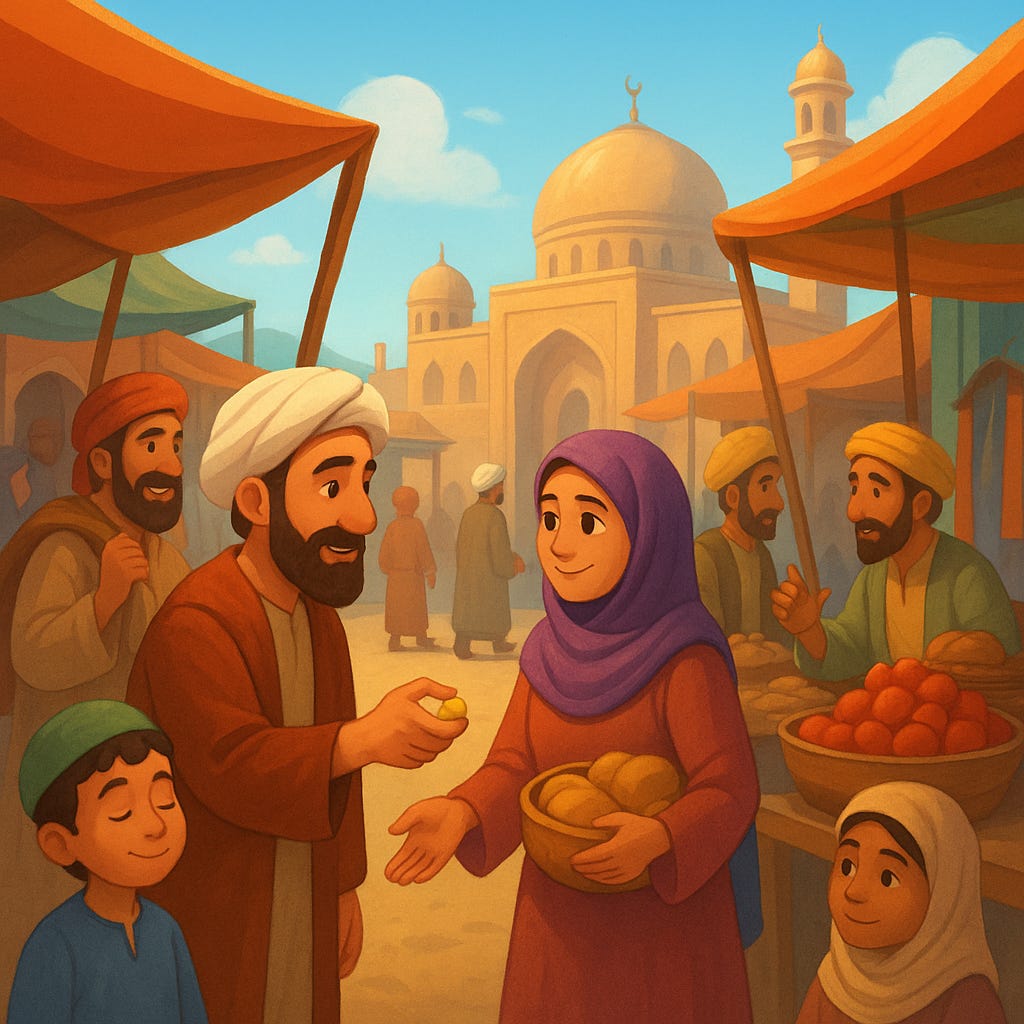
In a world divided by protectionism and inequality, Dr. Adeel Malik of Oxford University revisits Islam’s forgotten moral economy—one built on trade, charity, and the sacred circulation of prosperity. Drawing from early Meccan institutions to contemporary global dynamics, he invites the Ummah to rediscover an economics of solidarity that can transcend borders and revive the spirit of interconnectedness. This article is based on materials from Dr. Adeel Malik’s presentation at the Ummatics Colloquium, moderated by Usaama Al-Azami.
The Circulation at the Heart of Islamic Economy
Dr. Malik began not as a theologian, but as a political economist seeking to recover the moral logic underlying Islamic economic life. He argued that any genuine civilizational revival must begin with the creation of economic commons—shared spaces of exchange rooted in justice, solidarity, and moral purpose.
At the center of this vision lies a single, powerful motif: circulation.
Circulation, in the Islamic moral economy, operates on two interconnected planes. The first is visible—the tangible exchange of goods and services through trade. The second is invisible—the act of charity (sadaqah), conceptualized as a form of trade with God. Together, these two currents sustain life and community, forming a divinely sanctioned chain of reciprocity.
Trade, in this conception, is not merely an economic act but a sacred trust. Historically, Muslim traders understood their participation in markets as part of a divine order of circulation: even when profits were low, they kept goods moving, believing that economic flow itself was a form of worship. For Dr. Malik, trade is so central to Islam that it could be described as its “currency.”
From Tribal Raiding to Economic Solidarity
To illuminate this vision, Dr. Malik guided the audience back to pre-Islamic Mecca—a society transitioning from tribal raiding to organized commerce. Mecca’s designation as a Haram (sanctuary) created a rare environment of safety for trade, enabling new institutions that shifted Arabia’s equilibrium from conflict to cooperation.
Two key innovations marked this transformation. The first was the Hilf, a network of tribal alliances ensuring safe passage for caravans. The second—and far more revolutionary—was the Ilaf, pioneered by Hashim ibn ʿAbd Manaf, the Prophet Muhammad’s great-grandfather. The Ilaf expanded beyond tribal pacts: Meccan merchants negotiated with counterparts in Syria, offering to transport their goods to faraway markets in exchange for protection.
This institutional leap dramatically increased the scale of trade and market access. In modern terms, the Ilaf functioned like a regional trade agreement, fostering interdependence among tribes that had once survived by raiding each other’s caravans. The result was a new kind of economic solidarity—a moral economy in which prosperity depended on cooperation rather than conquest.
Yet, this prosperity also produced inequality. Wealth accumulated among powerful merchant clans, deepening social divisions. The old tribal system, rooted in polytheism and clan patronage, could not resolve these tensions. The ground was ready for a transformative idea—one that would unify the moral and economic orders.
Islam as an Institutional Revolution
Islam emerged, in Dr. Malik’s telling, as an institutional revolution that answered this moment of imbalance. Monotheism replaced the authority of the clan with the authority of God, liberating trade and charity from tribal privilege. Acts of exchange—both commercial and charitable—were reframed as universal duties rather than selective favors.
The Prophet Muhammad’s establishment of the marketplace in Medina epitomized this vision. His instruction not to “set up sections” within it and not to “impose taxes” reflected a radical ideal: a market open to all, unfragmented by monopolies, and free from exploitative exactions. In Dr. Malik’s interpretation, this was both an economic and a moral statement—markets must remain autonomous and participatory.
In early Islamic civilization, markets and mosques stood side by side, embodying the unity of moral and material life. The marketplace was understood as a sadaqah jariyah—a perpetual charitable endowment—because it created livelihood, dignity, and interdependence. This economics of solidarity became the engine of Islam’s civilizational expansion, carried along trade routes that stretched from the Maghreb to Southeast Asia.
The Hajj, too, served as a living embodiment of circulation—drawing together people, goods, and ideas into a dynamic annual network of exchange. Far from being purely ritualistic, it was once a central hub of commerce, technology, and culture that connected the Muslim world.
Fragmentation and the Loss of Circulation
Turning to the present, Dr. Malik lamented that the historical template of solidarity has largely vanished. Today, Muslim economies are among the least integrated in the world, with minimal intra-OIC trade and little economic cooperation. He identified several interlocking causes for this fragmentation.
First is the political economy of privilege. Protectionist elites and monopolistic interests profit from closed markets, insulating themselves from competition while ordinary citizens bear the costs.
Second is political insecurity. Many rulers view cross-border economic integration as a threat, fearing it could empower new centers of influence beyond their control.
Third are geopolitical constraints. Both global powers and local actors have incentives to maintain “thick borders,” preventing the emergence of a unified Muslim economic bloc that could wield collective bargaining power on the world stage.
In Dr. Malik’s view, even sacred practices have been reduced to individualized rituals stripped of their social and economic functions. The Hajj, for instance, once a catalyst for trade and cultural exchange, now fulfills only “half its philosophical purpose.” Its civilizational dimension—the mingling of crafts, ideas, and partnerships—has been lost to compartmentalized modernity.
Rethinking Ideology and the Moral Foundations of Economy
In the discussion that followed, participants probed deeper into the philosophical implications of Dr. Malik’s thesis. When asked whether Muslims should seek to construct a distinct “Islamic economic system,” he cautioned against rigid ideologies.
Rather than creating another “ism,” Dr. Malik urged a return to ethical universals: justice (ʿadl), public welfare (maṣlaḥa), and the prevention of exploitation. The central question, he argued, is not whether a system is capitalist or socialist, but who holds power, who creates value, and who extracts it. Every economy must be judged by how it balances power and ensures fairness.
He noted that ownership itself, in the Islamic worldview, is never absolute—it is a trust (amānah) before God. Wealth must serve as a conduit for community benefit, not a tool for domination. This ethic, exemplified in Caliph ʿUmar’s willingness to repossess idle land for public use, defines Islam’s pragmatic but principled approach to justice and prosperity.
Reclaiming the Spirit of Integration
How, then, can Muslims begin to rebuild the spirit of economic integration? Dr. Malik proposed a pragmatic roadmap grounded in gradual reform rather than grand utopian schemes.
He called for an intellectual awakening—a new generation of Muslim thinkers, economists, and scholars who are unafraid to question inherited orthodoxies and articulate bold visions of shared prosperity. The task, he emphasized, is not merely academic but civilizational: to imagine a moral economy that is modern, dynamic, and deeply rooted in Islamic principles.
Second, he urged the creation of networks—both material and intellectual—that can link business communities across borders. Regional chambers of commerce, trade associations, and cultural institutions can serve as bridges of collaboration.
Third, he highlighted the importance of mobility. Economic integration begins with human movement. Easing visa restrictions, improving connectivity, and encouraging travel for study and trade would reawaken the historical channels through which Muslim societies once thrived.
Finally, Dr. Malik emphasized cultural capital as a hidden resource. Morocco’s engagement with West Africa through shared Sufi traditions, for instance, demonstrates how spiritual and historical ties can become corridors of commerce. These “soft” networks can succeed where political alliances fail, cultivating trust and shared purpose.
Balancing Prosperity and Justice
Yet integration, Dr. Malik acknowledged, also carries risks—particularly rising inequality. As markets expand, the danger of concentration and exclusion increases. Islam’s emphasis on charity, zakat, and fair circulation offers built-in correctives to these tendencies, reminding societies that growth without justice is spiritually barren.
Monopoly, he argued, is not only economically inefficient but morally corrupt. In prophetic ethics, hoarding and price manipulation are sins because they disrupt divine circulation. Keeping markets open and competitive is therefore not just sound policy—it is a moral imperative.
The Ummah as a Civilizational Project
Dr. Malik concluded by reframing Islamic economic integration not as a political slogan but as a long-term civilizational project. True unity cannot be imposed from above; it must grow organically from networks of exchange, trust, and shared ethical purpose.
The early Islamic experience offers more than nostalgia—it offers a framework for imagining global interdependence without domination. In an age marked by protectionism, inequality, and xenophobic nationalism, Islam’s moral economy points toward an alternative vision of globalization: one grounded in reciprocity, justice, and mutual flourishing.
Reimagining the Ummah in this light requires both intellectual courage and moral imagination. It begins not with governments or grand institutions, but with the rediscovery of circulation—of goods, ideas, and compassion—across borders of geography and thought. Only then can the Ummah reclaim its place as a moral and economic community, bound together not merely by faith, but by a shared commitment to the well-being of all.
This article was written based on Dr. Adeel Malik’s presentation at the Ummatics Colloquium, moderated by Usaama Al-Azami. Generative AI was used to assist with restructuring, expansion, and image. Ummah International has no official relationship with Ummatics.