
If capitalism conquered the world by globalizing greed, then Islam can renew it by globalizing compassion

This article is adapted and expanded from a speech given by Dr. Ovamir Anjum, founder of the Ummatic Institute, at the Islamic Finance Conference at Harvard.
Across the Muslim world, hearts are heavy as we witness the suffering of Gaza. For two years, millions have seen images of deaths, starvation, and devastation, yet the fifty-seven nations that make up the ummah have been unable to mount significant help let alone realize free Palestine. This tragedy has become a mirror, revealing a painful truth: despite vast wealth, global presence, and growing influence, the ummah remains paralyzed in the face of injustice. Our collective grief must not descend into despair but rise as a call for renewal—a reminder that those most privileged with knowledge, education, and global opportunity bear the greatest responsibility to act. The Muslims studying at leading universities, working in powerful institutions, and shaping the future of industries are not mere spectators. They are the globally empowered Muslims whom Allah has entrusted with the means to heal and strengthen the ummah.
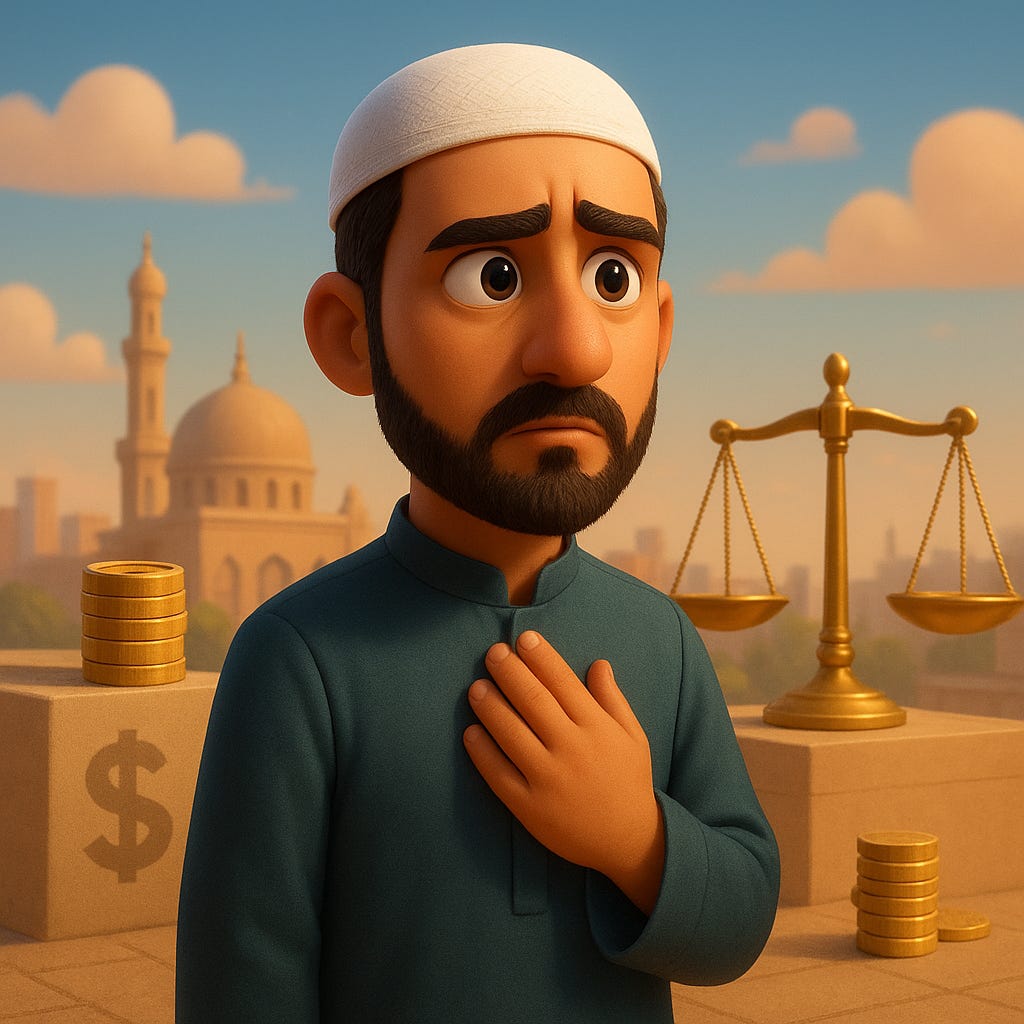
To do so requires rethinking how we understand markets, wealth, and morality. Islam has never stood against commerce. Trade lies at the heart of the prophetic tradition; it was through honest trade that the Prophet Muhammad ﷺ earned his title of al-Amin, the trustworthy. The problem, therefore, is not the existence of markets, but the transformation of the market into an idol—the elevation of profit from a means to a god. Islam’s economic vision is not anti-market; it is a moral market. It welcomes enterprise but anchors it in justice, compassion, and accountability before Allah. Capitalism, on the other hand, worships accumulation for its own sake and measures human worth by material gain.
Capitalism is often described as a system of freedom, but in reality it has always been tied to power and coercion. Its so-called “free markets” were forged through war, colonization, and state violence. It claims to be secular, yet readily harnesses religion when it serves profit. In America, for instance, the “prosperity gospel” teaches that wealth is proof of divine favor—a notion that has quietly seeped into Muslim societies as well. Capitalism’s genius lies in its ability to absorb even its critics, including religion itself, by turning them into instruments of consumption and control. What began as a system of trade has become a total worldview, redefining virtue as utility, success as accumulation, and progress as consumption.
At its core, capitalism deifies profit maximization. It strips away all ethical limits on the pursuit of gain, except those that protect the interests of the powerful. Under its logic, the value of a thing—and of a person—is determined by what can be extracted from it. The Islamic worldview stands in direct opposition to this. The testimony la ilaha illa Allah negates all false gods before affirming the one true God; capitalism, by contrast, has erected profit as a false deity that commands obedience across the globe. Its spiritual consequence is the loss of remembrance—forgetting Allah, the afterlife, and the moral purpose of wealth.
Islam’s resistance to this system does not rest merely on ethical exhortation but on law. Shariah translates moral principles into social and economic boundaries. It prohibits interest not to hinder enterprise, but to protect human dignity and prevent exploitation. It mandates zakat to circulate wealth and purify hearts. This legal-moral synthesis is precisely what makes Islam such a powerful alternative to capitalism. When religion loses its legal and ethical authority, it becomes easy to repurpose—an ornament of piety without transformative power. Once faith is stripped of its capacity to shape law, family, and public life, it risks becoming capitalism’s handmaiden, blessing the very system that destroys its moral foundation.
The modern project of Islamic economics arose after the collapse of the Ottoman Caliphate, as Muslims sought to reclaim autonomy from colonial capitalism. Early thinkers envisioned an economy guided by divine law and communal solidarity. Yet as the twentieth century unfolded, the rise of neoliberal globalization absorbed much of this effort. Islamic finance expanded rapidly, but its growth was often shaped by the same profit-driven logic it sought to transcend. While it offered valuable ethical tools, it increasingly resembled the very capitalist markets it was meant to critique. The result was material success but moral dilution—a system that spoke the language of Islam yet operated within the grammar of capitalism.
To restore its soul, Islamic economics must return to its ethical and communal roots. Real change begins not with institutions but with the moral choices of individuals and communities. Capitalism thrives on discontent, urging people to seek happiness through endless consumption. Islam resists by teaching contentment, service, and worship. Every act of prayer, care for family, or decision to prioritize duty over material advantage is an act of rebellion against the logic of greed. The practice of qard hasanah—interest-free loans given out of compassion—cannot exist in societies where trust has eroded. Such practices depend on strong local bonds, on people who see one another not as consumers but as brothers and sisters in faith. In this sense, rebuilding the ummah’s economy begins with rebuilding the ummah itself.
Yet the challenge is not only moral; it is structural. Today, trade among Muslim nations accounts for barely three percent of their total commerce. The economies of the ummah remain deeply tied to former colonial powers, locked in vertical relationships that perpetuate dependency. A true economic awakening will come only when Muslim societies begin to trade, invest, and innovate with one another. The Muslim world has far more to learn horizontally—from its own diverse experiences—than from imitation of the West. Countries like Indonesia, with their experiments in social enterprise and community-based finance, offer models of ethical modernization rooted in faith.
The path forward demands a new moral imagination: a spiritual economy that measures success not by GDP, but by justice, dignity, and nearness to Allah. The first act of resistance to capitalism is not a policy reform but a spiritual one—to remember the purpose of life, to treat wealth as trust, and to use power in service of the weak. Every generation of Muslims has faced its own tests; ours is to build an economy that restores balance between the material and the moral.
If capitalism conquered the world by globalizing greed, then Islam can renew it by globalizing compassion. The ummah’s renewal will not come from mimicking the world’s powers but from rediscovering its own. May Allah grant us the strength to build an economy that serves humanity, protects the oppressed, and honors the Creator—so that when we stand before Him, we can say with sincerity: we did our best.
This article was written based on original concepts from the Dr. Ovamir Anjum in his speech at the Islamic Finance Conference at Harvard. Generative AI was used to assist with restructuring, expansion, and image. Ummah International has no official relationship with Ummatics.
This is such a powerful message, and timely too. With the crazy inflation looming ahead, people realizing fiat money is really nothing, uncertainty everywhere and the US digging a hole for itself - the world is at inflection point. We, Muslims, either rise, or we will be sucked into the riptide as the West crumbles. Please count me in for Ummah’s digital money project!