
Merchants of Faith, Architects of Civilization

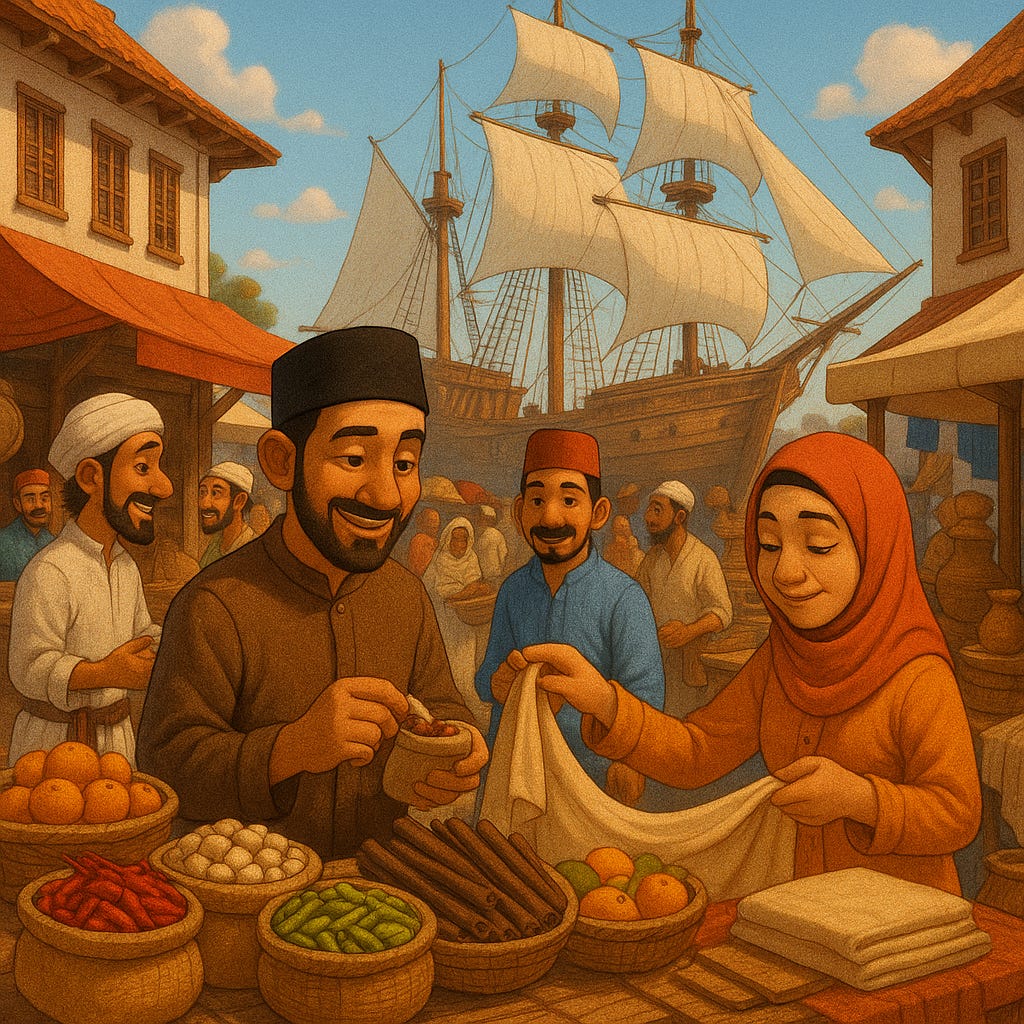
We often forget this simple truth:
Before the sword ever moved, the sail did.
Before Islam built empires, it built markets.
Before it conquered territories, it conquered hearts — through trust, ethics, and trade.
In today’s world, the word entrepreneur may conjure images of Silicon Valley founders or startup IPOs. But long before those buzzwords existed, Muslim entrepreneurs were sailing oceans, funding masjids, supporting scholars, and knitting the world together with trust and trade.
This is our heritage.
And it’s time we reclaimed it.
Karimi Merchants and the Ethics of Empire
Let’s start with the Karimis — a network of Muslim merchant families that dominated trade across the Red Sea and Indian Ocean in the 11th–14th centuries. Based in Egypt and Yemen, they were not just traders of spices and textiles — they were financiers, logisticians, and patrons of the Islamic world.
They lent capital to states, scholars, and artisans.
They built waqf (charitable endowments) to fund education and health.
They upheld transnational ethics — gaining trust across continents, from East Africa to India.
Their influence was so vast that when a Karimi ship arrived in port, it was treated as a diplomatic event. And yet, they did not build their reputation through violence or colonization — they built it through integrity.
Their motto was not “growth at all costs.” It was “barakah through trust.”
Hadhrami Traders and the Spread of Islam Without War
Centuries later, across the Arabian Peninsula, a different kind of entrepreneur set sail: the Hadhrami traders of Yemen.
They didn’t carry swords.
They didn’t hold titles.
They didn’t raise armies.
And yet, they Islamized entire regions — not with force, but with fairness.
From the Swahili coast of East Africa to the Malay archipelago, the Hadhrami were known for their humility, business ethics, and spiritual devotion. They opened shops. They married into local communities. They invested in education and upliftment.
In fact, Islam first arrived in what is now Indonesia — the world’s largest Muslim country — not through conquest, but through trade with Hadhrami, Gujarati, and Chinese Muslim merchants.
They proved something profound:
That commerce, when done with sincerity, is da’wah.
That profit, when aligned with principle, becomes purpose.
Serikat Dagang Islam: The Birth of Modern Muslim Economy
Fast forward to early 20th-century Nusantara. Colonial exploitation had ravaged the local economy, and native Indonesians were excluded from power and dignity.
And yet, from the heart of Java, a quiet revolution began — not with weapons, but with warehouses.
The Serikat Dagang Islam (Islamic Trade Union), founded by Haji Samanhudi in 1905, was not just a merchant guild. It was the first mass nationalist movement in the archipelago. What started as a network of Muslim batik traders became a political, economic, and spiritual force — calling for independence, unity, and economic sovereignty.
It reminded the world that trade is not neutral. It is either a tool of oppression — or a force for liberation.
Today, The Struggle Looks Different — But the Mission Remains
Today, you may not be steering a ship across the Indian Ocean.
You may be coding apps, running logistics, marketing modest fashion, or managing supply chains.
But don’t let the tools fool you.
The calling is the same.
To build lives — not just businesses.
To spread values — not just products.
To connect and uplift — not just compete.
Because the world doesn’t just need more startups. It needs more civilizational builders. Entrepreneurs who understand that their work sits on centuries of legacy — and that they hold the baton now.
UMMAH: Reviving the Spirit of Ethical Enterprise
This is why we built UMMAH.
Not just to network. Not just to share posts. But to gather the next generation of Hadhrami and Karimi — digital, global, visionary.
We believe in profit — but not empty scale.
We believe in growth — but growth that uplifts others.
We believe in community — because that’s where barakah lives.
UMMAH is here to help Muslim entrepreneurs and professionals connect across borders. To create meaningful ventures. To build something that outlives them.
Because long before Silicon Valley, our ancestors were the world’s innovators.
Because long before venture capital, we had waqf.
Because long before hashtags, we had caravans.
And because long before “unicorns” and “exits,” we had something far more powerful:
We had civilization.
It’s time we built it again.
This article was written based on original concepts and structure by the author. Generative AI was used to assist with elaboration, refinement, and image.
 | A guest post by
|