
The Ahi Brotherhood in Anatolia: Merchants Who Become Midwives of Great Sultanate

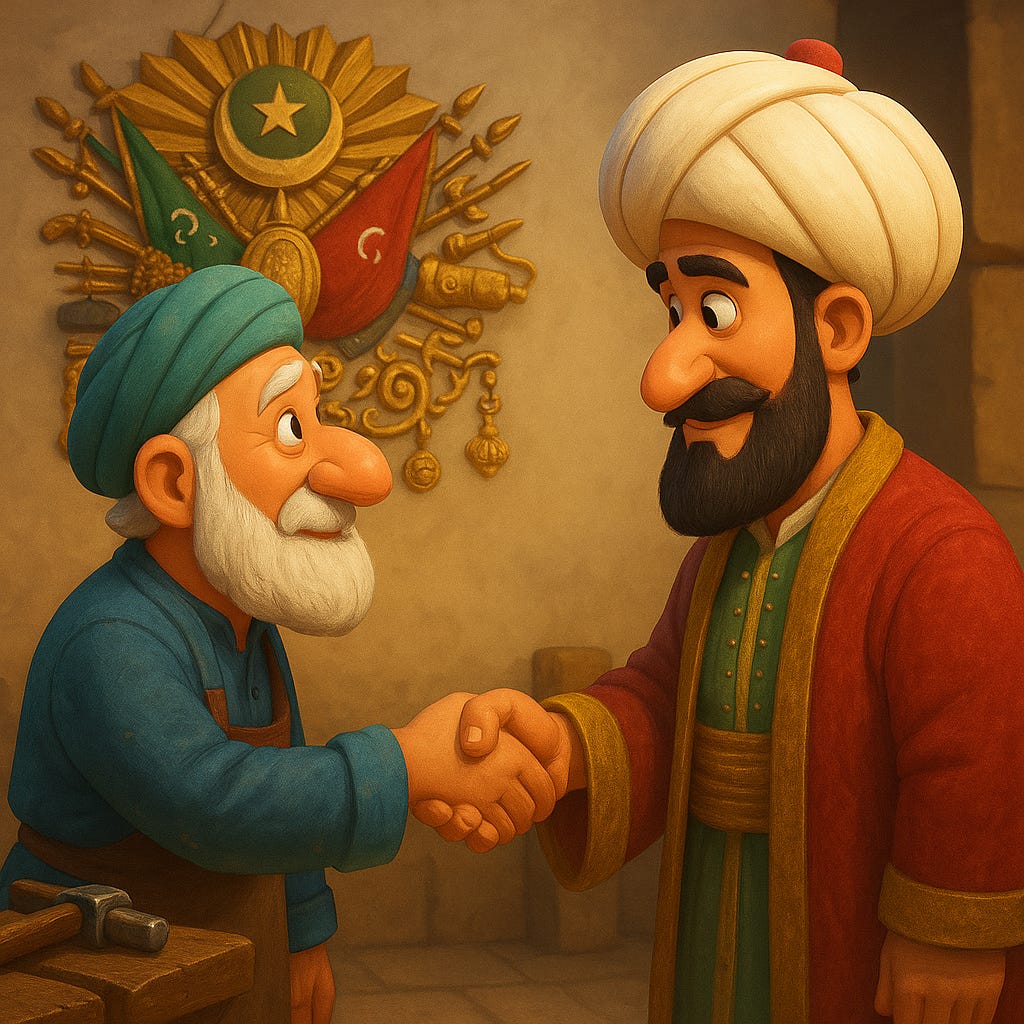
There are moments in history when empires collapse, institutions vanish, and leadership goes silent. And yet, somehow, society keeps moving. People still eat. Markets still open. Morality still breathes.
Often, this quiet survival is not driven by armies or kings. It is carried on the shoulders of ordinary people doing extraordinary things.
Such is the story of the Ahi Brotherhood—a guild of merchants, artisans, and traders in Anatolia, whose faith, discipline, and courage preserved not only commerce, but civilization itself.
Born in Chaos, Guided by Faith
The Ahi Brotherhood emerged in the 13th century during a time of profound instability. The once-mighty Seljuk Empire was disintegrating under the pressure of internal strife and the devastating Mongol invasions. In many parts of Anatolia, the state had collapsed. Justice had no enforcer. Institutions had no leaders. But the people still needed order, dignity, and hope.
Enter the Ahis.
Founded by Ahi Evran, a scholar, leatherworker, and Sufi deeply rooted in Islamic ethics, the Ahi Brotherhood organized artisans and traders into ethical, professional, and spiritual communities. They combined the rigor of business with the discipline of worship. They believed trade was not just a source of income, but an expression of jihad—a moral struggle to live and work in accordance with divine values.
Every member took an oath. To speak truthfully. To weigh fairly. To give zakat. To treat apprentices with compassion. To ensure the market was not just a place of profit, but a space of trust.
And they did all of this without a state to back them.
The Invisible Backbone of Society
While warlords fought for territory, the Ahis organized supply chains. While the Mongols burned cities, the Ahis rebuilt shops and schools. While political power shifted from one hand to another, the Ahis provided continuity, consistency, and character.
They became moral authorities in their towns. The community trusted them more than corrupt governors or foreign armies. Their guilds offered loans to struggling families. They educated youth in both craft and conduct. And when the Seljuk empire became a memory, the Ahi Brotherhood became the glue that held the fabric of Anatolian society together.
And then something remarkable happened.
Out of the ashes of post-Seljuk Anatolia, a small principality began to rise in northwestern Anatolia. It was young, fragile, and largely unknown.
Its name was Osman—the seed of what would become the Ottoman Empire.
The Ahis recognized something in this emerging force. They saw in its early rulers—Osman and Orhan—a desire for justice, Islamic governance, and social order. And so the Ahis lent more than their prayers. They gave moral legitimacy, intellectual input, and most importantly, financial support.
They provided funds. They built supply routes. They offered their networks of trust to a fledgling state that needed to build fast and govern well. In many ways, the Ottoman Empire was born not only by sword, but by spirit and commerce.
For over two centuries, the Ahis remained embedded in Ottoman urban life—ensuring quality, fairness, and justice in the marketplace. They were not merely merchants. They were guardians of conscience.
What We Must Learn Today
Today, many of us wear the title of entrepreneur, professional, or business leader. We seek growth, we chase innovation, we quote startup metrics. But what the Ahi Brotherhood reminds us is that our true worth lies not in what we build, but in how we build it.
They didn’t wait for perfect systems. They became the system. They didn’t just dream of justice. They embodied it—in prices, in policies, in daily transactions.
As Muslim professionals in the 21st century, their example challenges us to ask:
Is our trade built on sidiq and amanah, or on manipulation and spin?
Are we grooming the next generation with character, or just with skills?
Do our businesses serve society—or just shareholders?
Because true power is not in headlines or IPOs. It’s in becoming indispensable to your people. Just like the Ahis were.
This is what UMMAH aspires to be: a revival of that spirit. A gathering of ethical Muslim entrepreneurs and professionals who believe their work is not just about success, but about stewardship. That in times of chaos or calm, we stand firm. We organize. We serve.
We may not live in 13th century Anatolia. But we do live in uncertain times.
And perhaps, once again, it will not be empires or presidents who protect the soul of our people.
It will be you.
The faithful merchant.
The trusted professional.
The modern-day Ahi.
And Allah knows best.
This article was written based on original concepts and structure by the author. Generative AI was used to assist with elaboration, refinement, and image.